Asparagus
(Rates Based on “Per Acre”, with adequate soil nutrient/fertility)
NOTE: This program is presented as a guideline only. With the wide variances possible from both soil types and environmental conditions present during any particular season, your actual recommendation can vary from what is presented. It is always advisable to discuss actual management practices with your local representative.
Preparing a new asparagus planting begins the year prior to planting the crowns or plugs. Gaining control of perennial weeds and reducing the bank of weed seeds will go a long way to reducing potentially serious weed problems later as there are few herbicides labeled for asparagus. The ideal soil pH is 6.5-7, so if necessary, apply soil amendments such as lime or sulfur to achieve the desired soil pH.
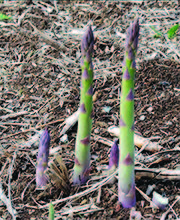
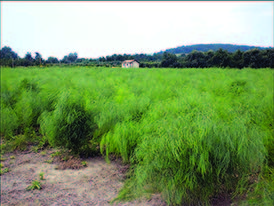
A careful, controlled management of harvest during the first few years speeds the establishment of a long-lasting stand. This is especially important during the first year of growth. Growing strong and vigorous ferns will strengthen the root, thus laying the foundation for a good harvest the following spring. Once the field has become established, crown vigor is all-important in maintaining stand and productive potential in coming seasons. Crown vigor is very dependent upon fern development, and how much solar energy the plant can capture and store in the crown and roots. Pre-emergent and post-harvest nutrient applications of granular fertilizers are the most common method of maintaining nutrient-related vigor, although there is some strong research showing the benefits of humic and amino acids, such as PhytoGro Xtra and MetaboliK HV-1.
ESTABLISHMENT YEAR – CROWNS: Before trenching, apply 75 – 100 units phosphorus, plus 75 units of potassium, plus 50 – 60 units of nitrogen, and incorporate. In soils with very high or low P or K levels, adjust this application as per soil test recommendations. Trench and lay crowns, then apply 16 – 24 fluid ounces PhytoGro Xtra, 16 ounces fluid Metabolik SB, and 1 pound of TifiMax per 100 gallons of solution as a pre-cover drench. Fill trenches, install drip irrigation (if available), and apply 2″ of water per week as needed based on weather. Apply 16 fluid ounces MetaboliK HV-1, either as a broadcast application or through the drip lines. Apply an additional 30 – 40 units N, plus 50 – 75 units P, and 60 – 100 K in late May.
ESTABLISHMENT YEAR – PLUGS/TRANSPLANTS: Follow the same granular application as with crowns, but use a transplant solution of 8 – 12 fluid ounces Metabolik SB + 16 – 24 fluid ounces PhytoGro Xtra + 8 – 10 pounds 10-45-10, and 1 pound TifiMax per 100 gallons to drench newly set plants.
IF SEEDING FOR FUTURE TRANSPLANTING: See “EARLY VIGOR.”
SECOND YEAR AND BEYOND: Apply 30 units of N, plus 25 – 30 units P, plus 75 units of K in early March prior to first spear emergence. Broadcast 16 fluid ounces Metabolik HV-1 and 32 fluid ounces PhytoGro Xtra once spears have begun to emerge. When spear size begins to noticeably lessen, discontinue further harvesting. After harvest, apply 40 units of N, plus 40 units P, plus 75 units K. (See additional recommendations on back.)
NOTE: Once annual harvest has been completed and fern emergence has begun (18-36″ ferns), it’s recommended to take a tissue sample to determine if your fertility program needs adjusting. As mentioned above, to a very large degree a strong harvest the following spring will be determined by the level of fern growth. Look for the following tissue analysis ranges: N: 2.4 – 3.8%, P: 0.3 – 0.4%, K: 1.5 – 2.4%, Ca: 0.4 – 0.5%, and Mg: 0.15 – 0.2%.
The recommendations listed below are shown with the assumption that this is an established field in at least the second year of growth. Recommendations are shown as stages of crop development. Again, it should be noted that maintenance of crop vigor is to a large degree determined by the strength of fern growth, which allows the root to replenish strength after harvest of spears. Once spear diameter begins to noticeably become more “pencil-like”, or spears are tending to “open” toward the spear tips, then harvest should be stopped and ferns allowed to develop.
ISP Soluble Plant Foods/Bio Products
| Stage/Time: | Per Acre | Other Notes, foliar applications, SiMag 58 |
| Pre-emergence | Minimum 100 pounds ammonium sulfate, other dry nutrients as recommended. | |
| Initial Spear Emergence (6″ Spears) | Broadcast as a foliar; 32 fluid ounces PhytoGro Xtra, and 16 fluid ounces MetaboliK HV-1, | Apply as a separate foliar, apply 32 fluid ounces SiPhite, and 32 fluid ounces SiGuard L. |
| Post Harvest, Pre-Fern Development | 3 gallons ReStore 3G | Apply as a broadcast. |
| 18″ Ferns | 10 pounds 28-16-7, 16 fluid ounces PhytoGro Xtra, 4 fluid ounces MetaboliK HV-1, 32 fluid ounces SiPhite. | Tissue sample to determine nutrient needs. A minimum of 100 pounds ammonium sulfate, 30 units P, 75 units K. Actual amounts should be adjusted based upon tissue results and recommendations. |
| 64 fluid ounces SiPhite | Apply as a broadcast foliar. Other nutrient applications may be made based upon observation or tissue analysis. Observe for asparagus miners or beetles. | |
| September | 15 pounds 4-18-38, 16 fluid ounces PhytoGro Xtra, 8 fluid ounces MetaboliK HV-1. | Apply as a broadcast foliar. In a separate foliar apply 32 fluid ounces SiGuard L. |
ADDITIONAL NOTES ON PHYTOPHTHORA: Phytophthora can be a serious limiting factor in field longevity and productivity. Although it may not lead to plant death, it can seriously damage crown vigor resulting in decreasing yield. Research on phosphite (the primary component of SiPhite) has shown to be effective in reducing susceptibility. Being systemic, applications to the ferns will move through the plant into the root zone. In some waters, SiPhite may not be compatible with ISP plant foods. A jar test is recommended, and if necessary, apply SiPhite as a separate application.